
The SPARKFUZE™ electrode coating process
A patented exothermal process that impregnates catalysts into the substrate in a single, sub-minute, low-temperature step — delivering higher ECSA, greater durability and lower cost.

A new way to coat electrodes
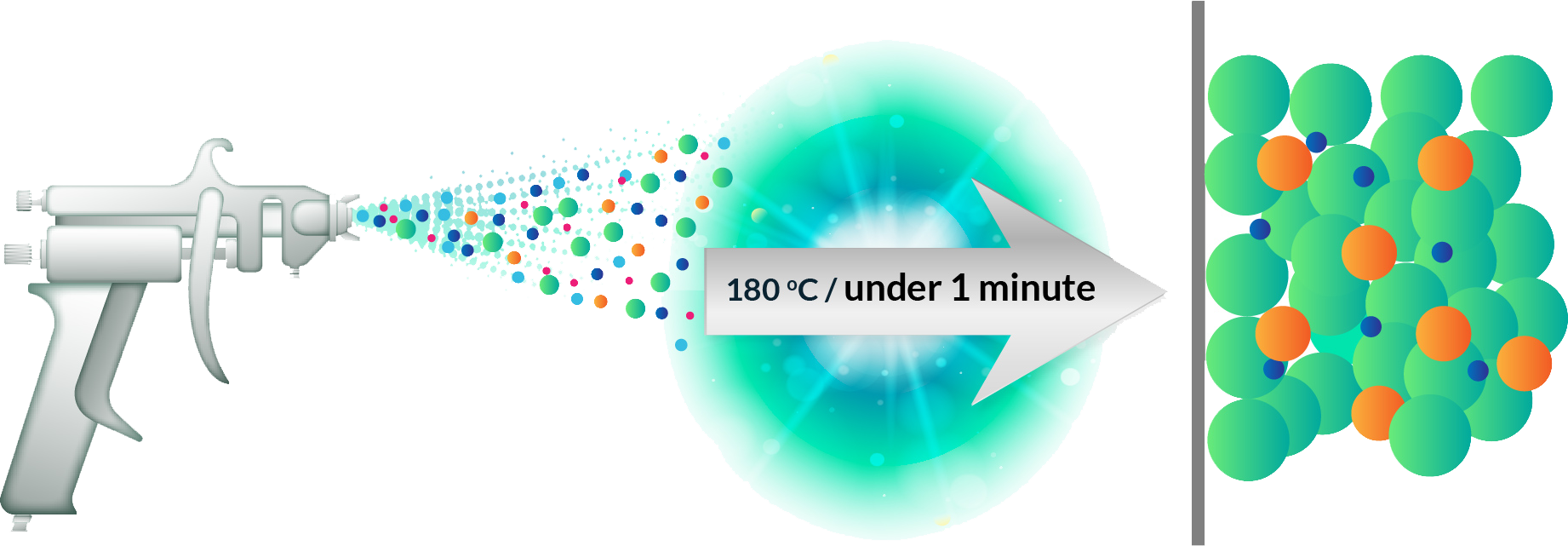
SPARKFUZE™ is Jolt's patented process for applying catalyst coatings to electrode substrates. It uses a controlled exothermal reaction to impregnate active species directly into the surface, forming a high electrochemically active surface area (ECSA) layer in a single step.
Unlike traditional manufacturing — which stacks multiple coatings over hours at 400°C+ — SPARKFUZE™ needs just one layer, applied in under a minute, at only 180°C. The result: more durable, more efficient, lower-cost electrodes, produced with a fraction of the energy.
The process is substrate-agnostic, catalyst-agnostic and can reduce or eliminate precious metal loading — letting our customers tailor each electrode to the exact performance and economics of their application.
Standard manufacture vs. SPARKFUZE™
Catalysis is core to decarbonisation — yet, until now, it has operated on last-century technology.
Standard manufacture
- Multiple coating layers required
- Each coating > 1 hour
- High operating temperature > 400°C
- High energy consumption
- Heavy reliance on rare-earth catalysts
- Slow, hard to scale globally
SPARKFUZE™
- Single coating layer
- Under 1 minute per coating
- Low operating temperature: 180°C
- Over 75% less CO₂ emissions
- Can reduce or eliminate PGMs
- Fully automated and globally deployable
Six reasons SPARKFUZE™ is transformative
One process replaces a century of slow, energy-intensive coating methods — and opens a new performance ceiling for electrochemistry.
Ultra-fast coating
Each electrode is coated in under 1 minute — vs. multiple hours in conventional processes — enabling fully automated, high-throughput production lines.
Low-temperature, low-power
Operating at just 180°C, SPARKFUZE™ uses a fraction of the energy of traditional 400°C+ coating, slashing electricity and gas consumption per m².
Higher ECSA & durability
The exothermal reaction creates a high Electrochemically Active Surface Area — more active sites per cm², longer operational life (10 years+).
PGM reduction
SPARKFUZE™ can drastically reduce — or eliminate — the use of platinum-group and rare-earth metals, lowering material costs and supply-chain risk.
Catalyst flexibility
Works with any desired catalyst mix. Formulations can be tailored to each customer's application, substrate and performance target.
Globally deployable
Each SPARKFUZE™ line is modular and automated. Capacity up to 400,000 m²/year, replicable close to customer production sites in 8–9 months.
How SPARKFUZE™ works, end to end
From raw nickel substrate to ready-to-deploy electrode — in a single, continuous coating pass.
Everything you need to know
The ten most common questions we get from customers, investors and partners about Jolt and the SPARKFUZE™ process.
Jolt Solutions is a deep tech coating company. Our first multi-GW electrode manufacturing plant is based in Spain, with more to follow. Jolt's new patented process — SPARKFUZE™ — uses an exothermal reaction to impregnate catalysts into the surface of the substrate and create high ECSA layers.
Jolt Solutions has developed a proprietary process to apply catalyst coatings to electrodes. This allows for automated and scalable production of electrodes which are more durable, more efficient and cost effective.
Jolt's first commercial offerings are focused on AWE / AEM electrolysis for hydrogen production. As a coating company, we are expanding into other electrolysis applications including salt-water chlorinators, waste-water treatment, PEM electrolysis, electrowinning, cathodic protection and chlor-alkali.
Our Barcelona factory acts as our pilot line and benchmarking hub. It is designed to coat a variety of substrates with different catalysts, with capacity up to 100,000 m²/year. Once business is established with a customer, we sign offtake agreements and replicate the line close to their production sites — each line automated and capable of up to 400,000 m²/year, deployed in 8–9 months.
Yes — in 10 KW AEM stacks and 500 KW AWE demonstrator stacks. Our products are available at scale and have already been used to produce electrodes greater than 4.5 m².
SPARKFUZE™ can deposit catalyst layers between 0.2–2 mg/cm². These layers have been shown to be consistent across the surface, giving uniform electrochemical activity.
Nickel-based substrates including Flynet, Expanded Mesh, Wire Mesh, Foam and Felt. We are developing pre-treatments and coatings for titanium and stainless steel. The process is very gentle and has even been used successfully to coat Zirfon diaphragms.
Green hydrogen currently costs 4–5× more than fossil fuels (target: $1–$1.50 / kg). Reducing electrode cost is core to unlocking the sector. Jolt's electrochemistry breakthrough is a lever to unlock green hydrogen's full potential.
Commercial manufacturing started in Q2 2024. Fully automated production lines are ready to roll out. The SPARKFUZE™ process is patented and fully tested.
The SPARKFUZE™ process emits over 75% less CO₂ than traditional coating methods. Our platform also enables the creation of new catalysts that do not require rare-earth materials.
Test SPARKFUZE™ on your substrate
Send us your substrate and target specs. We will coat it in our Barcelona line and return performance data for your application.